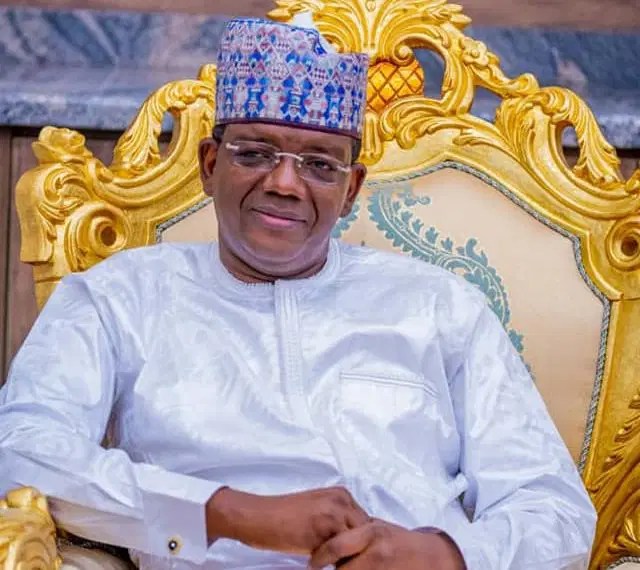
How Dr. MB Shehu is Transforming RMAFC to a World-class Institution

How Dr. MB Shehu is Transforming RMAFC to a World-class Institution

By Salisu Ibrahim

Revenue Mobilization Allocation and Fiscal Commission (RMAFC), a key Institution of the Federal Republic of Nigeria, is becoming more visible and impactful in its pursuit of fair and equitable distribution of the nation’s resources.
Thanks to the visionary leadership of its Chairman, Dr Muhammad Bello Shehu whose strategic approach to leadership, good governance and accountability is leaving a transparent and accountable footprint in the Commission’s
fiscal operations.

The country is now witnessing a robust fiscal operations in fulfilment of the Commission’s Constitution role.

The Constitution has mandated RMAFC to monitor revenue accruals and disbursements as well as determine remuneration for public office holders.

This task is by no means daunting, yet the Commission’s management under the Chairmanship of Dr. Muhammed Bello Shehu is up and doing in meeting up with the nation’s expectations.

A cursory look at how the Chairman runs the affairs of the Commission in collaboration with the board and the management is what’s working in the strategic repositioning of the Commission’s operations.

In all its activities, the Commission focuses on data collection and analysis from government agencies to achieve its mandate, while it reviews revenue allocation formulae every five years, just to ensure fair and equitable distribution of resources.
This perhaps, explain why, RMAFC has been at the forefront of calls for a reduction in the day-to-day government expenditure, and ensuring that public funds are spent judiciously and for the welfare of the people.

Dr. Muhammed Bello Shehu, as Chairman has created a very conducive atmosphere for workers to function effectively. He is undoubtedly promoting the principles of transparency and accountability in Nigeria’s fiscal operations in the management of Nigeria’s vital resources, and is enjoying the support of his management team and board members.

Under his leadership, RMAFC, has been up and doing, implementing various strategies to meet the nation’s and public expectations.

So far, the Commission has developed a clear roadmap and accessible strategies that focuses on transparency and accountability, while reaching out to the relevant stakeholders to enhance its visibility and impact.

Beside that, the Commission has launched several initiatives to enhance its visibility and impact, by developing an acceptable and transparent framework for the management of derivation funds.

Additionally, the Commission has engages consultants to drive the recovery of unremitted revenues, remain open for public scrutiny and has launched several initiatives to promote transparency and accountability as it engages with citizens and relevant stakeholders.

Fiscal efficiency and revenue mobilization as is being driven by the Commission, is currently supporting sustainable economic development of the country, with the Commission leading the process and making it to work for the Nation’s growth.

Under Dr. Muhammed Bello Shehu’s leadership, RMAFC is committed to promoting transparency and accountability in Nigeria’s fiscal operations. It has successfully provided a framework for equitable distribution of resources among federal, state, and local governments, while enhancing fiscal efficiency and revenue mobilization to support sustainable economic development of the country.

The leadership vision of Dr MB Shehu is to transform the Commission to become a world-class institution, that is promoting transparency and accountability in Nigeria’s fiscal operations, as it ensures equitable distribution of resources for the benefit of all Nigerians.

Salisu Ibrahim contributed this piece from Kano, could be reached on faccageltd10@gmail.com

Ganduje’s Independent Hisbah Initiative, a recipe for dangerous politicization of religion

Ganduje’s Independent Hisbah Initiative, a recipe for dangerous politicization of religion

By Aminu Hussaini

“Nigeria’s history is replete with examples of how religious tensions can escalate into violence and instability. In this opinion, the writer examine the proposed Independent Hisbah initiative by Dr. Abdullahi Umar Ganduje, former Governor of Kano State, and warned that at moments of national anxiety, leadership is revealed not by noise but by restraint.”

In an era when insecurity stalks daily life and the national mood is brittle with fear, any political actor who toys with public order, pursues disaster. This is why the recent push to create an “independent Hisbah Fisabilillah” by former Kano State Governor Abdullahi Umar Ganduje deserves no applause, but serious public scrutiny.

Let us be clear: this is not a debate about faith, morality or the place of religion in society. Kano has long negotiated the coexistence of culture, belief and governance. The issue at hand is far more troubling—an apparent insensitivity to the risks of insecurity and social fracture, wrapped in a desperate bid to salvage fading political relevance.

At a time when Nigerians are weary—of violence, of economic hardship, of the weaponization of identity—the introduction of a parallel moral enforcement structure outside established legal frameworks is not courage. It is recklessness!

A Dangerous Nostalgia for Control: The attempt for an “independent” Hisbah is a loaded action. Independence from what, exactly? From the law? From due process? From democratic accountability?

In a country grappling with armed non-state actors, vigilantism and the erosion of trust in institutions, proposing another body with coercive overtones is a provocative gamble with public safety. It is difficult to escape the conclusion that this move is less about public morality and more about political resurrection. When relevance wanes, spectacle often follows. Creating a moral panic, positioning oneself as the guardian of values and daring the state to react—these are old tricks in the populist handbook. But old tricks can still cause new damage.

Kano Government’s Quiet Strength- Against this backdrop, the response of the Kano State Government under the leadership of AKY has been instructive. Rather than descend into political mudslinging or ideological confrontation, the government has chosen the unglamorous but essential path: law, due process and public-order mechanisms. This is leadership that understands the moment- Instead of escalating tension, the state has emphasized that security and social regulation must remain within constitutionally recognized institutions. Instead of politicizing faith, it has grounded its response in legality. Instead of street-level theatrics, it has opted for calm institutional clarity. In a fragile national environment, this restraint matters. Public order is not maintained by competing power centers but by coherence. Justice is not served by parallel authorities but by transparent and accountable systems.

Faith Is Not a Political Lifeline- There is something particularly tragic about invoking religion as a political lifeline. Faith, for millions, is sacred, personal and unifying rather than devising. To deploy it as a tool for political comeback cheapens its moral authority and risks inflaming divisions that the country can ill afford.
The danger is not hypothetical. History—both local and global—is littered with examples where unofficial moral enforcers became instruments of intimidation, selective justice and social fear. In today’s Nigeria, with its volatile mix of economic stress and security threats, such experiments are not just ill-advised; they are irresponsible!

The Choice Before Us- Kano stands at a crossroads that mirrors Nigeria’s broader dilemma: do we address our challenges through institutions or impulses? Through law or loudness? Through governance or grandstanding? The Kano State Government has, so far, chosen the harder but wiser road. It has refused to be baited into confrontation. It has prioritized public order over political drama. That choice deserves recognition, not because it is perfect, but because it is principled. In times like these, leadership is not about who shouts the loudest or claims the highest moral ground. It is about who understands that stability is fragile, that insecurity feeds on confusion and that politics should never be allowed to masquerade as piety.

Nigeria has enough fires burning. The country do not need desperate matches struck in the name of relevance.

Barrister Aminu Hussaini is Special Adviser to the Governor of Kano State – AKY on Justice/Constitutional Matters – could be reached on +234 8033742424 – aminuhussaini173@gmail.com

Group Dismisses Allegations Against CAC Registrar-General

Group Dismisses Allegations Against CAC Registrar-General

The National Forum for Good Governance (NFGG) has dismissed allegations of misconduct leveled against the Registrar-General of the Corporate Affairs Commission (CAC), Hussaini Ishaq Magaji, SAN, describing the claims as unfounded, malicious and politically motivated.

The allegations followed a petition formally received by the House of Representatives, calling for an investigation into the alleged unlawful tampering with the corporate records of Jonah Capital Nigeria Ltd and Houses for Africa Nigeria Ltd by the CAC Registrar-General.

The petition, written on behalf of the two companies, alleged that some corporate records were altered to favour a contending party in an internal dispute.

However, in a statement issued on Sunday, the National Chairman of the forum, Chairman is Dr Mukhtar Mustapha Bebeji, expressed strong confidence in the integrity, professionalism and leadership of Magaji, insisting that the accusations lacked credible evidence.

According to the forum, a careful review of the allegations revealed no verifiable facts to support the claims, adding that the accusations appeared aimed at discrediting the CAC and undermining public confidence in a key regulatory institution.

“The National Forum for Good Governance wishes to categorically state that after a thorough review of the claims being circulated, we find the allegations against the CAC Registrar-General to be baseless and unsupported by any credible or verifiable facts,” the statement read.

The forum urged members of the public and stakeholders to exercise restraint and avoid spreading unverified information capable of damaging the reputation of public institutions.

It advised aggrieved parties to seek redress through lawful and established channels, stressing that genuine concerns should be directed to appropriate regulatory and oversight bodies to allow for due process and fair investigation.

Alhaji Bebeji also commended the Corporate Affairs Commission for its ongoing reforms aimed at simplifying business registration processes, strengthening regulatory compliance and improving Nigeria’s ease of doing business.

The forum further appealed to the media to uphold ethical journalism standards by ensuring accuracy, balance and fairness in reporting, and cautioned against amplifying allegations that have not been substantiated.

Painting Competition: Shehu Sani Highlights Power of Art in National Development

Former Kaduna Central Senator, Comrade Shehu Sani, has reiterated the power of art as a unifying force and a catalyst for national development, as he sponsored and graced a Painting Competition held on Wednesday at the Kaduna Museum.

The event, which attracted dozens of young artists, students, cultural enthusiasts and community leaders, showcased a variety of paintings reflecting themes of peace, unity, diversity and social harmony.

Speaking during the ceremony, Sani said the competition was conceived to encourage creativity among young Nigerians and to provide them with a platform to express themselves freely through visual arts. According to him, painting and other creative expressions have the capacity to bridge divides, foster tolerance and strengthen national cohesion.

He noted that art remains a universal language that communicates across ethnic, religious and political barriers, making it a strategic tool for promoting peaceful coexistence in a multicultural society like Nigeria.

“Art has the power to heal, to unify and to inspire,” Sani said. “What these young artists have demonstrated today is that creativity can serve as a panacea for our national challenges, including unemployment, social tension and the lack of opportunities for the youth.”

The former senator emphasised that investment in art and creative industries can contribute significantly to job creation, tourism growth and youth empowerment. He urged government agencies, cultural institutions, NGOs and private-sector actors to support similar initiatives that highlight the talents of young Nigerians.

Sani also commended the participants for their outstanding works, promising to continue supporting programmes that promote creativity, skill development and peaceful engagement among young people.

Curators at the Kaduna Museum and coordinators of the competition praised Sani for his consistent commitment to cultural development and youth empowerment, stressing that the event would inspire many young artists to pursue careers in the creative sector.

Winners of the competition received certificates, cash prizes and art materials, while their works are expected to be displayed at the museum and other public exhibitions aimed at promoting peace and unity.

Kano at a Turning Point: Building on Government Successes to Secure a Sustainable Housing FutureBy Barr. Aminu Hussaini

As Kano State continues to affirm its position as one of Nigeria’s most dynamic economic and population hub, a major opportunity lies ahead: transforming its growing urban landscape through smarter planning, stronger regulation and deeper collaboration with the private sector.In recent years, the state has witnessed a rapid rise in demand for residential land, driven by population growth, urban migration and economic expansion.

While this heightened demand has encouraged private developers to supply residential plots at unprecedented scale, an increasing number of these private layouts emerged without adequate planning, infrastructure or regulatory approval, placing both residents and government agencies at risk.Government Achievements: A Foundation Worth Celebrating Despite these challenges, the Kano State Government under the leadership of AKY has made remarkable strides in improving land administration, urban planning and infrastructure delivery.

From digitizing key aspects of land records to strengthening the operations of land management agencies, the government has taken bold steps to enhance transparency, reduce bureaucratic bottlenecks and promote orderly development.Key achievements include the introduction of more structured land allocation processes that prioritize fairness and efficiency; revitalization of planning agencies, improving their capacity to assess and approve layouts according to modern standards and improved monitoring and enforcement against unauthorized developments, expansion of government-serviced layouts as well as provision of safer and more affordable residential options.

Why Stronger Regulation Still Matters Even with these gains, the increasing proliferation of substandard private layouts means regulation and oversight must remain a priority. Many of these unapproved layouts lack essential infrastructure and pose long-term risks.Public–Private Partnership: The Key to Sustainability One of the most important lessons from modern urban development worldwide is that government effort alone is not enough — sustainability is best achieved when public institutions and private developers work hand-in-hand. With proper PPP frameworks, developers can co-invest in roads, drainage, energy and water systems while government ensures clear standards, oversight and incentives.

Together, both sides can build high-quality and well-planned residential communities.A Shared Responsibility for a Shared FutureKano’s transformation can neither be left solely to government agencies nor entirely to private developers. Sustainability depends on mutual responsibility, where government maintains strong oversight, private investors build responsibly and communities embrace regulated housing options.ConclusionKano stands at a pivotal moment in its development journey. The state government’s outstanding achievements in strengthening land administration and urban planning have laid a strong foundation for progress. The next phase requires complementary partnership with private developers to sustain this momentum and ensure every resident has access to safe – modern housing.

With continued government leadership and responsible private-sector participation, Kano under the AKY is set to become a national model for sustainable urban growth.This opinion piece was written by Barrister Aminu Hussaini – Special Adviser to the Governor of Kano State – AKY on Justice/Constitutional Matters – +234 8033742424 – aminuhussaini173@gmail.com

Kano at a Turning Point: Building on Government Successes to Secure a Sustainable Housing FutureBy Barr. Aminu Hussaini

As Kano State continues to affirm its position as one of Nigeria’s most dynamic economic and population hub, a major opportunity lies ahead: transforming its growing urban landscape through smarter planning, stronger regulation and deeper collaboration with the private sector.In recent years, the state has witnessed a rapid rise in demand for residential land, driven by population growth, urban migration and economic expansion. While this heightened demand has encouraged private developers to supply residential plots at unprecedented scale, an increasing number of these private layouts emerged without adequate planning, infrastructure or regulatory approval, placing both residents and government agencies at risk.Government Achievements: A Foundation Worth CelebratingDespite these challenges, the Kano State Government under the leadership of AKY has made remarkable strides in improving land administration, urban planning and infrastructure delivery.

From digitizing key aspects of land records to strengthening the operations of land management agencies, the government has taken bold steps to enhance transparency, reduce bureaucratic bottlenecks and promote orderly development.Key achievements include the introduction of more structured land allocation processes that prioritize fairness and efficiency; revitalization of planning agencies, improving their capacity to assess and approve layouts according to modern standards and improved monitoring and enforcement against unauthorized developments, expansion of government-serviced layouts as well as provision of safer and more affordable residential options.

Why Stronger Regulation Still Matters Even with these gains, the increasing proliferation of substandard private layouts means regulation and oversight must remain a priority.

Many of these unapproved layouts lack essential infrastructure and pose long-term risks.Public–Private Partnership: The Key to SustainabilityOne of the most important lessons from modern urban development worldwide is that government effort alone is not enough — sustainability is best achieved when public institutions and private developers work hand-in-hand. With proper PPP frameworks, developers can co-invest in roads, drainage, energy and water systems while government ensures clear standards, oversight and incentives. Together, both sides can build high-quality and well-planned residential communities.

A Shared Responsibility for a Shared FutureKano’s transformation can neither be left solely to government agencies nor entirely to private developers. Sustainability depends on mutual responsibility, where government maintains strong oversight, private investors build responsibly and communities embrace regulated housing options.ConclusionKano stands at a pivotal moment in its development journey.

The state government’s outstanding achievements in strengthening land administration and urban planning have laid a strong foundation for progress. The next phase requires complementary partnership with private developers to sustain this momentum and ensure every resident has access to safe – modern housing.With continued government leadership and responsible private-sector participation, Kano under the AKY is set to become a national model for sustainable urban growth.

This opinion piece was written by Barrister Aminu Hussaini – Special Adviser to the Governor of Kano State – AKY on Justice/Constitutional Matters – +234 8033742424 – aminuhussaini173@gmail.com

NSNCM Backs Matawalle, Urges President Tinubu to Retain Him as Minister of State for Defence

NSNCM Backs Matawalle, Urges President Tinubu to Retain Him as Minister of State for Defence

The Nineteen Seventeen Northern Consensus Movement (NSNCM), a coalition of 598 registered associations across the 19 Northern states and Northern communities in the 17 Southern states, has declared firm support for the Minister of State for Defence, Dr. Bello Mohammed Matawalle, urging President Bola Ahmed Tinubu to retain him in office in the interest of national security.

Addressing a press conference in Abuja, the National President of the movement, Dr. Awwal Abdullahi Aliyu, said the organization—one of the largest socio-political coalitions in the region—convened the briefing to commend recent security appointments by the President and to restate the importance of continuity within the defence leadership.

Dr. Aliyu applauded President Tinubu for appointing General Christopher Gwabin Musa as the new Minister of Defence, describing him as a “detribalized, highly accomplished and patriotic military leader.” He said Musa’s experience and national outlook have inspired fresh confidence among Nigerians.

He also commended the former Defence Minister, Mohammed Badaru Abubakar, who resigned on health grounds, noting that his dedication and achievements remain appreciated.

The movement, however, devoted much of its statement to defending Dr. Matawalle against what it described as politically motivated calls for his removal.

According to Dr. Aliyu, Dr. Matawalle has demonstrated “genuine commitment, responsiveness and visible results” both as Governor of Zamfara State and as Minister of State for Defence. He cited key achievements, including the rescue of abducted schoolgirls in Kebbi State, the strengthening of multi-agency intelligence-sharing structures, and advocacy for improved military funding and modernization.

He recalled Matawalle’s efforts as Governor between 2019 and 2023, during which he confronted severe banditry through a mix of community dialogue, intelligence-driven operations and enforcement. His Peace and Reconciliation Initiative, the establishment of Community Protection Guards, and coordination with security agencies reportedly contributed to reopening closed roads, reviving farming activities and reducing attacks in affected communities.

Dr. Aliyu dismissed recent calls for Matawalle’s removal as “political resentment” from long-standing adversaries uncomfortable with his loyalty to President Tinubu and contributions to the Renewed Hope Agenda.

He clarified that defence ministers do not command troops, as operational control rests with the service chiefs under the constitutional authority of the President. Rather, ministers provide policy direction, administrative coordination and strategic guidance. He added that the law does not require the minister to be a serving or retired military officer, emphasizing that competence and integrity remain the key criteria.

Highlighting recent gains in civil-military relations, community intelligence flow and stakeholder engagement, the NSNCM argued that removing Matawalle at this time would disrupt emerging progress in ongoing security reforms.

“At this critical point in Nigeria’s fight against insecurity, continuity is essential,” Dr. Aliyu said. “The synergy between the Minister of Defence and the Minister of State for Defence is beginning to yield results, and the nation needs leadership stability to consolidate these gains.”

He urged President Tinubu to disregard “mischief makers and politically motivated distractors” seeking to undermine Matawalle, noting that the group’s 598 affiliate associations are committed to mobilizing support for peace, unity and cooperation with security agencies nationwide.

Dr. Aliyu reaffirmed the movement’s pledge to contribute to grassroots intelligence gathering, community sensitization and national stability.

Girie’s Bid for Adamawa Gov’ship Gains Momentum as Grassroots Movement Spreads Across the State

Girie’s Bid for Adamawa Gov’ship Gains Momentum as Grassroots Movement Spreads Across the State

…I reflected not on faces but on impact, my mind immediately rested on Dr. Salihu Bakari Girei, whose achievements in the education sector had shaped the experience of countless children”

By Tom Garba

The governorship aspiration of Dr. Salihu Bakari Girei is rapidly transforming into a full-fledged movement across Adamawa State, as an increasing number of residents, community leaders, technocrats, farmers, students and political stakeholders continue to publicly declare support for his emergence as the All Progressives Congress (APC) flagbearer in the 2027 gubernatorial race.

What began as scattered endorsements from individuals who admired his work has now evolved into a groundswell of unified voices insisting that the state deserves his brand of leadership; one rooted in competence, vision, and a legacy of tangible achievements.

Across Yola, Girei, Hong, Madagali and other local government areas, the sentiment is the same: Dr. Girei stands out as a uniquely qualified figure whose past service in education and public administration provides a clear blueprint for the kind of future Adamawa residents desire.

Most of the endorsements emerging in recent weeks are not driven by political associations or personal connections, but by the impact he has left on communities, schools and families throughout the state.

This was captured vividly by Mr. Tönamonashi Odede Wilson, a supporter from Yola who openly declared that he came to admire Dr. Girei without ever meeting him.

Wilson explained that his admiration was born during a casual conversation with Hajiya Saadatu Babaji, a highly respected community figure whose views often provoke deep reflection.

When she asked him who he considered the most suitable personality to govern Adamawa, he found himself reflecting not on familiarity or political alignments but on the concrete legacies left behind by those who had served.

“I reflected not on faces but on impact,” he said, explaining that his mind immediately rested on Dr. Salihu Bakari Girei, whose achievements in the education sector had shaped the experience of countless children.

He recalled how, as Chairman of the State Universal Basic Education Board (SUBEB), Dr. Girei’s leadership produced visible changes; renovated classrooms, modern teaching environments, improved access to education and the steady refinement of school infrastructure.

These, he believed, were the marks of a leader who understood that governance must be felt, not just spoken about. In his words, Dr. Girei’s work “campaigned for him silently and effectively,” leading him to support a man he had only come to know through the change he brought to communities. “He is a good man with a lion’s heart,” Wilson declared.

His views were echoed by Mr. Iyke Nnamni, a long-time resident of Adamawa State who said he had personally benefited from Dr. Girei’s generosity.

Nnamni’s enthusiastic endorsement captured in his repeated chant “Sai Bakari, Sai Girei, Sai Salihu!”—captures the growing energy among supporters who believe the former education administrator represents a new era of purposeful leadership.

Much of the growing enthusiasm for Dr. Girei stems from his long and impactful journey through education, public administration and community development. Supporters often recount this trajectory with pride, describing him as a man who has risen from modest roots to attain global academic exposure and national leadership roles, all while staying deeply connected to his community.

According to Hon. Ishaq B. Aliyu, who has followed Dr. Girei’s career closely, the governorship hopeful embodies the story of hard work and excellence.

Born and raised in Girei, he commenced his education at what is now known as Lamido Lawal Primary School, before moving on to Government Day Secondary School, Girei. From there he proceeded to the University of Maiduguri, graduating with his first degree before obtaining a second degree from the University of Jos.

His academic journey eventually took him to the United Kingdom, where he earned a PhD from the prestigious University of Sussex.

Upon his return to Nigeria, Dr. Girei joined the Federal College of Education in Yola as a lecturer, steadily rising to become Dean of the Faculty of Education. His academic contributions were far-reaching: he published more than thirty scholarly journals, authored five books and participated in numerous international conferences that expanded his exposure to global trends in educational development.

His transition into public administration occurred under the government of former Governor Murtala Nyako, who appointed him Director-General of the State Planning and Project Unit (SPPU).

His performance in that role paved the way for his appointment as Chairman of the Adamawa State Universal Basic Education Board (SUBEB), where he is widely credited with delivering one of the most ambitious and far-reaching educational transformations in the state’s history.

As Director-General of the state planning and Project Unit (SPPU), Dr. Girie pioneered the establishment of Farming Skills Acquisition Centres and rolled out the Local Apprenticeship Scheme across the state.

He also spearheaded the creation of Technical Training Centres and introduced conditional cash transfers targeted at indigent and vulnerable groups.

This innovative social protection initiative so impressed the then Minister of Finance, Dr. Ngozi Okonjo-Iweala, that she personally visited to study it. The programme subsequently served as a key model that contributed to the design and nationwide rollout of the SURE-P initiative in Nigeria.

Dr. Girie’s achievements touched every sector critical to the state’s development, driving economic growth and lifting thousands out of poverty. These were transformative policies with the potential to fundamentally alter the developmental trajectory of the state for generations to come.

Supporters highlight how, under his oversight, thousands of new classrooms were constructed, model schools were established across all local government areas, teachers and supervisors were empowered with mobility support, and school environments received critical upgrades.

His achievements later earned him another key position; Commissioner for Local Government and Chieftaincy Affairs, where he continued to serve with integrity and commitment.

To many Adamawa residents, these accomplishments represent the kind of experience and credibility that should guide the state into the future. As one enthusiastic supporter, Mr. Bakari Liman, declared in Hausa, “Muna tare da Dr dari rana. Allah ya bamu nasara”—a testimony to the confidence many now place in his leadership.

While many recognise Dr. Girei for his contributions to education, his supporters also point to his well-articulated vision for transforming agriculture, which remains the backbone of the state’s economy.

This vision, they argue, is precisely what Adamawa needs at a time when farmers are struggling with inadequate infrastructure, limited access to modern tools and high post-harvest losses.

According to Mr. Lado Salisu M. Garba, who passionately endorsed Dr. Girei’s candidacy, the former SUBEB chairman has a detailed and practical understanding of what must be done to uplift the agricultural sector.

He described a future administration under Dr. Girei as one that would prioritise modern farming techniques, support farmers with improved seeds, fertilizers and mechanized tools, and ensure the provision of rural infrastructure such as feeder roads, irrigation facilities and storage centres.

He added that Dr. Girei’s policies would encourage youth participation in agribusiness, strengthen cooperative societies and protect farmers through pricing policies that ensure fair returns on their labour.

Garba believes these measures would reposition Adamawa as a leading agricultural hub in Nigeria, creating jobs, enhancing food security and empowering thousands of rural households.

Others who share this belief include Mr. Hamman Laminu, who responded with optimism, saying “Allah ya bamu nasara,” confident that Dr. Girei would bring meaningful change to the agricultural sector and beyond.

Endorsements Continue to Pour In

From the northern part of the state to the southern communities, testimonies about Dr. Girei’s character, competence and impact continue to surface. Mr. Umar Farouq Lamza described him as a “mutumin kirki” and “wakilin makarantun Adamawa,” phrases that portray him as a good man and a true representative of the state’s educational sector.

His endorsement reflects the widespread recognition of Dr. Girei’s contributions not only to formal education but to human capacity development as a whole.

In Madagali, Mr. Robert Samson, a lecturer at the College of Education in Hong, recalled meeting Dr. Girei in the United Kingdom in 2018. He described him as “a very good person, gaskiya,” and fondly remembered the warmth and humility Dr. Girei displayed during their interactions abroad.

As the 2027 election season inches closer, the drumbeat of support continues to grow louder. More voices are joining the call for the APC to nominate Dr. Salihu Bakari Girei as its gubernatorial candidate, pointing to his wealth of experience in governance, his deep academic grounding, his visionary approach to development and his track record of results in every public position he has held.

For now, the momentum appears not only steady but accelerating, as Adamawa residents across diverse sectors rally behind a man many believe embodies the leadership qualities needed to usher the state into a new era of progress and stability.

‘A Fit Choice’: The Case for Gen. Musa as Nigeria’s Next Defense Minister

‘A Fit Choice’: The Case for Gen. Musa as Nigeria’s Next Defense Minister

By Tom Garba

As the echoes of Defence Minister Mohammed Badaru Abubakar’s resignation still reverberate through the corridors of power in Aso Rock, one name towers above the speculation swirling in Nigeria’s security circles: General Christopher Gwabin Musa (retd.), the recently retired 18th Chief of Defence Staff (CDS).

With President Bola Ahmed Tinubu facing mounting pressure to fill the vacancy amid a relentless wave of banditry, insurgency, and cross-border threats, the appointment of Gen. Musa as the next Minister of Defence isn’t just a logical step, it’s an imperative, a masterstroke that could redefine Nigeria’s fight for peace.

Badaru’s abrupt exit on December 1, citing health concerns in a terse letter to the President, comes at a precarious juncture.

Tinubu’s administration, already lauded for bold reforms, cannot afford a misstep here. Enter Gen. Musa: a battle-hardened tactician, a visionary reformer, and a patriot whose proven track record screams “fit choice” louder than any political resume ever could.

In the cutthroat arena of national security, where hesitation costs lives and resolve builds nations, Gen. Musa’s elevation to Defence Minister would signal Tinubu’s unyielding commitment to results over rhetoric.

As someone who’s shadowed troops from the Sambisa Forest to the Zamfara badlands, reporting on the blood, sweat, and strategy that define our armed forces, I can attest: Musa isn’t just qualified; he’s the antidote to complacency.

His return to the fold, fresh from a private audience with the President just hours before Badaru’s announcement, feels less like coincidence and more like destiny unfolding.

Why Gen. Musa? The Unassailable Case

Nigeria’s security apparatus demands a leader who blends kinetic firepower with non-kinetic finesse, who turns intelligence into action and despair into discipline.

Gen. Musa, hailing from Zangon Kataf in Kaduna State and commissioned into the Nigerian Army in 1991 after excelling at the Nigerian Defence Academy, embodies this rare alchemy.

His career isn’t a checklist of postings; it’s a chronicle of triumphs that have bent the arc of our nation’s security toward hope.

Under his stewardship as CDS from June 2023 to October 2025, the Armed Forces of Nigeria (AFN) didn’t just hold the line—they advanced it.

Musa inherited a fractured force reeling from years of asymmetric warfare, yet he forged it into a symphony of synergy: inter-agency collaboration, troop welfare, and global partnerships that elevated Nigeria from a cautionary tale to a continental powerhouse.

Musa’s legacy is one of accountability and evolution; lessons learned, standards raised, and human rights woven into every operation.

Tinubu, who appointed him CDS in a move hailed as a “square peg in a square hole,” knows this better than anyone.

Reappointing Musa as Defence Minister would turbocharge the President’s Renewed Hope agenda, ensuring seamless continuity while injecting fresh strategic vigor.

In a cabinet reshuffle speculated to prioritize technocrats over politicians, Musa stands as the gold standard: apolitical, results-driven, and fiercely loyal to the troops who bleed for us.

A Legacy of Victories: Gen. Musa’s Notable Achievements

Here’s a curated list of his standout feats, drawn from declassified operations, official Defence Headquarters tallies, and eyewitness accounts from the frontlines—each a brick in the fortress of his candidacy:

Nigerian troops achieved massive neutralizations and surrenders, neutralizing more than 3,000 terrorists and bandits, apprehending thousands more, and most crucially inducing the surrender of thousands insurgents, including high-value Boko Haram commanders, while operations like Hadin Kai in the Northeast systematically dismantled ISWAP enclaves, with the first quarter of 2024 alone recording 2,352 terrorist kills, 2,308 arrests, and 1,241 hostage rescues; Musa did not merely fight but broke the enemy’s will, turning foot soldiers into informants and their once-safe havens into graveyards.

From schoolchildren in Kaduna to entire villages in Niger, his intelligence-led operations freed more than 2,000 kidnap victims in just two years, dealing a devastating blow to the ransom economies that fuelled criminal empires, and his “people-first” doctrine that prioritised swift, humane interventions earned him the enduring title “The Rescuer General,” with grateful families across the North erecting shrines in his honour.

As a modernisation maestro, Musa personally spearheaded the training and arming of 800 elite Special Operations Forces personnel at Camp Kabala, Jaji, drove Defence Industries Corporation of Nigeria (DICON) innovations such as locally produced drones and armoured vehicles, and introduced sweeping welfare reforms including better pay, mental health support, and family grants that boosted troop morale by 40% according to internal Armed Forces surveys, slashed desertions, and transformed the military into a truly 21st-century fighting force.

On the diplomatic front, his relentless shuttle diplomacy with Russian, Pakistani, and British defence chiefs, coupled with hosting the African Chiefs of Defence Conference in Abuja in August 2025, unlocked billions of naira in aid and technology transfers, while his deft visit to Niger Republic defused cross-border tensions and the restructuring of Northwest operations into unified commands like Fansan Yamma fortified Nigeria’s Sahel flank, burnishing the country’s global image and earning him honours such as Officer of the Order of the Federal Republic (OFR) and the 2023 Lifetime Achievement Award from the Nigeria Service Awards.

These are not abstract metrics; they are lives saved, communities rebuilt, and a nation steadied on the very brink of collapse.

The Bigger Picture: Why Now, Why Him?

Appointing Gen. Musa would be Tinubu’s chess grandmaster move: bridging military expertise with civilian oversight, silencing critics of “political appointments,” and accelerating gains from his CDS era.

With the Senate’s nod all but assured—given his unblemished service and northern roots—he could hit the ground running, targeting root causes like economic sabotage via illegal mining and youth radicalization.

Gen. Musa doesn’t lead from afar—he leads from the foxhole. That’s the minister we need. President Tinubu, the ball is in your court. Make the fit choice. Make it Musa.

Tom Garba is the Publisher of TGNews and an investigative journalist with over two decades of experience covering Nigeria’s security sector.

Christian, Muslim Leaders Hail Yari’s Peace Efforts, Urge Politicians to Emulate Him

Christian, Muslim Leaders Hail Yari’s Peace Efforts, Urge Politicians to Emulate Him

Christian and Muslim leaders in the North, under the umbrella of the Interfaith Unity Forum, have commended Senator Abdul’Aziz Yari for his sustained efforts toward promoting peace, unity and sustainable development across the region.

The leaders praised the former Zamfara State Governor for convening the recently well-attended Yari Roundtable for Interreligious Harmony held in Abuja and Kaduna, which brought together prominent clerics from both faiths to chart a new course for peaceful coexistence.

In a joint message signed by the co-chairs and secretaries — Pastor Eziekel Jeremiah Garba, Sheikh Muhammad Sabiu, Sheikh Nafiu Salman and Evangelist Musa Simon — the forum said Senator Yari deserved recognition for “restoring interreligious harmony among Christians and Muslims in the North.” They noted that the platform he created was helping to rebuild trust and strengthen communal bonds.

“We have repeatedly told those who care to listen that there is no alternative to peaceful coexistence and unity,” the leaders stated. “We should never allow ourselves to be divided on the grounds of tribe or religion.”

They lamented that some political office holders were more interested in power than in uniting the people, accusing them of exploiting ethnic and religious sentiments for political gain.

The leaders, therefore, urged other politicians — especially those currently in office — to emulate Senator Yari’s bold initiative in championing dialogue and promoting peace.

“Senator Abdul’Aziz Yari has taken a commendable step to ensure that peace and unity are restored in the North. We call on all leaders to follow this example for the progress of our region and the country at large,” they added.

Sen. Laah, AGM, Others in Alleged Coalition to Stop SMK from Securing 2027 APC Ticket

Bomba Dauda 

Former Senator Danjuma Laah has intensified his bid to return to the Senate in 2027, with emerging reports suggesting that he is working to prevent a repeat of his 2023 primary defeat. Laah, who lost the 2023 PDP primary to the current senator while still a sitting federal lawmaker, is said to be mobilising political forces ahead of the next election cycle.

Sources within the political circle reveal that Laah has entered into a strategic alliance with Rep. Amos Gwamna Magaji (AGM) and other stakeholders in a bid to stop Senator Sunday Marshall Katung (SMK) from securing the All Progressives Congress (APC) senatorial ticket for Kaduna South in 2027.

Observers say the development reflects Laah’s growing concern over SMK’s rising political influence. Analysts note that the emerging coalition is built on the belief that a united front may succeed where individual efforts previously fell short.

Both Laah and Magaji are believed to have lingering political grievances against SMK. However, the incumbent senator appears unbothered, maintaining a calm disposition and showing no interest in engaging in political hostilities.

The roots of the tension stretch back to 2019, when SMK defeated Magaji in the PDP House of Representatives primaries for the Jaba–Zangon Kataf Federal Constituency. But, when the then, PDP governorship candidate Isa Ashiru Kudan selected SMK as his running mate, SMK relinquished his House of Representatives ticket. Against the expectations of party stakeholders and despite guidelines requiring a fresh primary, SMK insisted that Magaji, as the runner-up, should be given the ticket, an uncommon gesture that drew surprise within the party. Where exactly SMK and AGM relationship turns acidic, observers say, remains a mystery. 

Meanwhile, Senator SMK has reiterated that his priority remains delivering quality representation to Nigeria and, particularly, to Southern Kaduna. He emphasised that “this is not the time for politics and I cannot be distracted, as I am busy delivering quality, responsible, and responsive representation to the good people of Southern Kaduna in the Red Chamber.”

The senator further stated that Southern Kaduna voters are politically mature and capable of discerning which candidate is best suited to represent them, adding that every aspirant will ultimately have to rely on their record of service.

Design a site like this with WordPress.com
Get started